From the White House, the text of
President Obama's remarks in the US Capitol on Tuesday night.
Click here for all posts about the President's SOTU address.
THE WHITE HOUSE
Office of the Press Secretary
_____________________________________________
For Immediate Release
January 24, 2012
REMARKS BY THE PRESIDENT
IN STATE OF THE UNION ADDRESS
United States Capitol
Washington, D.C.
9:10 P.M. EST
THE PRESIDENT: Mr. Speaker, Mr. Vice President, members of Congress, distinguished guests, and fellow Americans:
Last month, I went to Andrews Air Force Base and welcomed home some of our last troops to serve in Iraq. Together, we offered a final, proud salute to the colors under which more than a million of our fellow citizens fought -- and several thousand gave their lives.
We gather tonight knowing that this generation of heroes has made the United States safer and more respected around the world. (Applause.) For the first time in nine years, there are no Americans fighting in Iraq. (Applause.) For the first time in two decades, Osama bin Laden is not a threat to this country. (Applause.) Most of al Qaeda’s top lieutenants have been defeated. The Taliban’s momentum has been broken, and some troops in Afghanistan have begun to come home.
These achievements are a testament to the courage, selflessness and teamwork of America’s Armed Forces. At a time when too many of our institutions have let us down, they exceed all expectations. They’re not consumed with personal ambition. They don’t obsess over their differences. They focus on the mission at hand. They work together.
Imagine what we could accomplish if we followed their example. (Applause.) Think about the America within our reach: A country that leads the world in educating its people. An America that attracts a new generation of high-tech manufacturing and high-paying jobs. A future where we’re in control of our own energy, and our security and prosperity aren’t so tied to unstable parts of the world. An economy built to last, where hard work pays off, and responsibility is rewarded.
We can do this. I know we can, because we’ve done it before. At the end of World War II, when another generation of heroes returned home from combat, they built the strongest economy and middle class the world has ever known. (Applause.) My grandfather, a veteran of Patton’s Army, got the chance to go to college on the GI Bill. My grandmother, who worked on a bomber assembly line, was part of a workforce that turned out the best products on Earth.
The two of them shared the optimism of a nation that had triumphed over a depression and fascism. They understood they were part of something larger; that they were contributing to a story of success that every American had a chance to share -- the basic American promise that if you worked hard, you could do well enough to raise a family, own a home, send your kids to college, and put a little away for retirement.
The defining issue of our time is how to keep that promise alive. No challenge is more urgent. No debate is more important. We can either settle for a country where a shrinking number of people do really well while a growing number of Americans barely get by, or we can restore an economy where everyone gets a fair shot, and everyone does their fair share, and everyone plays by the same set of rules. (Applause.) What’s at stake aren’t Democratic values or Republican values, but American values. And we have to reclaim them.
Let’s remember how we got here. Long before the recession, jobs and manufacturing began leaving our shores. Technology made businesses more efficient, but also made some jobs obsolete. Folks at the top saw their incomes rise like never before, but most hardworking Americans struggled with costs that were growing, paychecks that weren’t, and personal debt that kept piling up.
In 2008, the house of cards collapsed. We learned that mortgages had been sold to people who couldn’t afford or understand them. Banks had made huge bets and bonuses with other people’s money. Regulators had looked the other way, or didn’t have the authority to stop the bad behavior.
It was wrong. It was irresponsible. And it plunged our economy into a crisis that put millions out of work, saddled us with more debt, and left innocent, hardworking Americans holding the bag. In the six months before I took office, we lost nearly 4 million jobs. And we lost another 4 million before our policies were in full effect.
Those are the facts. But so are these: In the last 22 months, businesses have created more than 3 million jobs. (Applause.)
Last year, they created the most jobs since 2005. American manufacturers are hiring again, creating jobs for the first time since the late 1990s. Together, we’ve agreed to cut the deficit by more than $2 trillion. And we’ve put in place new rules to hold Wall Street accountable, so a crisis like this never happens again. (Applause.)
The state of our Union is getting stronger. And we’ve come too far to turn back now. As long as I’m President, I will work with anyone in this chamber to build on this momentum. But I intend to fight obstruction with action, and I will oppose any effort to return to the very same policies that brought on this economic crisis in the first place. (Applause.)
No, we will not go back to an economy weakened by outsourcing, bad debt, and phony financial profits. Tonight, I want to speak about how we move forward, and lay out a blueprint for an economy that’s built to last -– an economy built on American manufacturing, American energy, skills for American workers, and a renewal of American values.
Now, this blueprint begins with American manufacturing.
On the day I took office, our auto industry was on the verge of collapse. Some even said we should let it die. With a million jobs at stake, I refused to let that happen. In exchange for help, we demanded responsibility. We got workers and automakers to settle their differences. We got the industry to retool and restructure. Today, General Motors is back on top as the world’s number-one automaker. (Applause.) Chrysler has grown faster in the U.S. than any major car company. Ford is investing billions in U.S. plants and factories. And together, the entire industry added nearly 160,000 jobs.
We bet on American workers. We bet on American ingenuity. And tonight, the American auto industry is back. (Applause.)
What’s happening in Detroit can happen in other industries. It can happen in Cleveland and Pittsburgh and Raleigh. We can’t bring every job back that’s left our shore. But right now, it’s getting more expensive to do business in places like China. Meanwhile, America is more productive. A few weeks ago, the CEO of Master Lock told me that it now makes business sense for him to bring jobs back home. (Applause.) Today, for the first time in 15 years, Master Lock’s unionized plant in Milwaukee is running at full capacity. (Applause.)
So we have a huge opportunity, at this moment, to bring manufacturing back. But we have to seize it. Tonight, my message to business leaders is simple: Ask yourselves what you can do to bring jobs back to your country, and your country will do everything we can to help you succeed. (Applause.)
We should start with our tax code. Right now, companies get tax breaks for moving jobs and profits overseas. Meanwhile, companies that choose to stay in America get hit with one of the highest tax rates in the world. It makes no sense, and everyone knows it. So let’s change it.
First, if you’re a business that wants to outsource jobs, you shouldn’t get a tax deduction for doing it. (Applause.) That money should be used to cover moving expenses for companies like Master Lock that decide to bring jobs home. (Applause.)
Second, no American company should be able to avoid paying its fair share of taxes by moving jobs and profits overseas. (Applause.) From now on, every multinational company should have to pay a basic minimum tax. And every penny should go towards lowering taxes for companies that choose to stay here and hire here in America. (Applause.)
Third, if you’re an American manufacturer, you should get a bigger tax cut. If you’re a high-tech manufacturer, we should double the tax deduction you get for making your products here. And if you want to relocate in a community that was hit hard when a factory left town, you should get help financing a new plant, equipment, or training for new workers. (Applause.)
So my message is simple. It is time to stop rewarding businesses that ship jobs overseas, and start rewarding companies that create jobs right here in America. Send me these tax reforms, and I will sign them right away. (Applause.)
We’re also making it easier for American businesses to sell products all over the world. Two years ago, I set a goal of doubling U.S. exports over five years. With the bipartisan trade agreements we signed into law, we’re on track to meet that goal ahead of schedule. (Applause.) And soon, there will be millions of new customers for American goods in Panama, Colombia, and South Korea. Soon, there will be new cars on the streets of Seoul imported from Detroit, and Toledo, and Chicago. (Applause.)
I will go anywhere in the world to open new markets for American products. And I will not stand by when our competitors don’t play by the rules. We’ve brought trade cases against China at nearly twice the rate as the last administration –- and it’s made a difference. (Applause.) Over a thousand Americans are working today because we stopped a surge in Chinese tires. But we need to do more. It’s not right when another country lets our movies, music, and software be pirated. It’s not fair when foreign manufacturers have a leg up on ours only because they’re heavily subsidized.
Tonight, I’m announcing the creation of a Trade Enforcement Unit that will be charged with investigating unfair trading practices in countries like China. (Applause.) There will be more inspections to prevent counterfeit or unsafe goods from crossing our borders. And this Congress should make sure that no foreign company has an advantage over American manufacturing when it comes to accessing financing or new markets like Russia. Our workers are the most productive on Earth, and if the playing field is level, I promise you -– America will always win. (Applause.)
I also hear from many business leaders who want to hire in the United States but can’t find workers with the right skills. Growing industries in science and technology have twice as many openings as we have workers who can do the job. Think about that –- openings at a time when millions of Americans are looking for work. It’s inexcusable. And we know how to fix it.
Jackie Bray is a single mom from North Carolina who was laid off from her job as a mechanic. Then Siemens opened a gas turbine factory in Charlotte, and formed a partnership with Central Piedmont Community College. The company helped the college design courses in laser and robotics training. It paid Jackie’s tuition, then hired her to help operate their plant.
I want every American looking for work to have the same opportunity as Jackie did. Join me in a national commitment to train 2 million Americans with skills that will lead directly to a job. (Applause.) My administration has already lined up more companies that want to help. Model partnerships between businesses like Siemens and community colleges in places like Charlotte, and Orlando, and Louisville are up and running. Now you need to give more community colleges the resources they need to become community career centers -– places that teach people skills that businesses are looking for right now, from data management to high-tech manufacturing.
And I want to cut through the maze of confusing training programs, so that from now on, people like Jackie have one program, one website, and one place to go for all the information and help that they need. It is time to turn our unemployment system into a reemployment system that puts people to work. (Applause.)
These reforms will help people get jobs that are open today. But to prepare for the jobs of tomorrow, our commitment to skills and education has to start earlier.
For less than 1 percent of what our nation spends on education each year, we’ve convinced nearly every state in the country to raise their standards for teaching and learning -- the first time that’s happened in a generation.
But challenges remain. And we know how to solve them.
At a time when other countries are doubling down on education, tight budgets have forced states to lay off thousands of teachers. We know a good teacher can increase the lifetime income of a classroom by over $250,000. A great teacher can offer an escape from poverty to the child who dreams beyond his circumstance. Every person in this chamber can point to a teacher who changed the trajectory of their lives. Most teachers work tirelessly, with modest pay, sometimes digging into their own pocket for school supplies -- just to make a difference.
Teachers matter. So instead of bashing them, or defending the status quo, let’s offer schools a deal. Give them the resources to keep good teachers on the job, and reward the best ones. (Applause.) And in return, grant schools flexibility: to teach with creativity and passion; to stop teaching to the test; and to replace teachers who just aren’t helping kids learn. That’s a bargain worth making. (Applause.)
We also know that when students don’t walk away from their education, more of them walk the stage to get their diploma. When students are not allowed to drop out, they do better. So tonight, I am proposing that every state -- every state -- requires that all students stay in high school until they graduate or turn 18. (Applause.)
When kids do graduate, the most daunting challenge can be the cost of college. At a time when Americans owe more in tuition debt than credit card debt, this Congress needs to stop the interest rates on student loans from doubling in July. (Applause.)
Extend the tuition tax credit we started that saves millions of middle-class families thousands of dollars, and give more young people the chance to earn their way through college by doubling the number of work-study jobs in the next five years. (Applause.)
Of course, it’s not enough for us to increase student aid. We can’t just keep subsidizing skyrocketing tuition; we’ll run out of money. States also need to do their part, by making higher education a higher priority in their budgets. And colleges and universities have to do their part by working to keep costs down.
Recently, I spoke with a group of college presidents who’ve done just that. Some schools redesign courses to help students finish more quickly. Some use better technology. The point is, it’s possible. So let me put colleges and universities on notice: If you can’t stop tuition from going up, the funding you get from taxpayers will go down. (Applause.) Higher education can’t be a luxury -– it is an economic imperative that every family in America should be able to afford.
Let’s also remember that hundreds of thousands of talented, hardworking students in this country face another challenge: the fact that they aren’t yet American citizens. Many were brought here as small children, are American through and through, yet they live every day with the threat of deportation. Others came more recently, to study business and science and engineering, but as soon as they get their degree, we send them home to invent new products and create new jobs somewhere else.
That doesn’t make sense.
I believe as strongly as ever that we should take on illegal immigration. That’s why my administration has put more boots on the border than ever before. That’s why there are fewer illegal crossings than when I took office. The opponents of action are out of excuses. We should be working on comprehensive immigration reform right now. (Applause.)
But if election-year politics keeps Congress from acting on a comprehensive plan, let’s at least agree to stop expelling responsible young people who want to staff our labs, start new businesses, defend this country. Send me a law that gives them the chance to earn their citizenship. I will sign it right away. (Applause.)
You see, an economy built to last is one where we encourage the talent and ingenuity of every person in this country. That means women should earn equal pay for equal work. (Applause.) It means we should support everyone who’s willing to work, and every risk-taker and entrepreneur who aspires to become the next Steve Jobs.
After all, innovation is what America has always been about. Most new jobs are created in start-ups and small businesses. So let’s pass an agenda that helps them succeed. Tear down regulations that prevent aspiring entrepreneurs from getting the financing to grow. (Applause.) Expand tax relief to small businesses that are raising wages and creating good jobs. Both parties agree on these ideas. So put them in a bill, and get it on my desk this year. (Applause.)
Innovation also demands basic research. Today, the discoveries taking place in our federally financed labs and universities could lead to new treatments that kill cancer cells but leave healthy ones untouched. New lightweight vests for cops and soldiers that can stop any bullet. Don’t gut these investments in our budget. Don’t let other countries win the race for the future. Support the same kind of research and innovation that led to the computer chip and the Internet; to new American jobs and new American industries.
And nowhere is the promise of innovation greater than in American-made energy. Over the last three years, we’ve opened millions of new acres for oil and gas exploration, and tonight, I’m directing my administration to open more than 75 percent of our potential offshore oil and gas resources. (Applause.) Right now -- right now -- American oil production is the highest that it’s been in eight years. That’s right -- eight years. Not only that -- last year, we relied less on foreign oil than in any of the past 16 years. (Applause.)
But with only 2 percent of the world’s oil reserves, oil isn’t enough. This country needs an all-out, all-of-the-above strategy that develops every available source of American energy. (Applause.) A strategy that’s cleaner, cheaper, and full of new jobs.
We have a supply of natural gas that can last America nearly 100 years. (Applause.) And my administration will take every possible action to safely develop this energy. Experts believe this will support more than 600,000 jobs by the end of the decade. And I’m requiring all companies that drill for gas on public lands to disclose the chemicals they use. (Applause.) Because America will develop this resource without putting the health and safety of our citizens at risk.
The development of natural gas will create jobs and power trucks and factories that are cleaner and cheaper, proving that we don’t have to choose between our environment and our economy. (Applause.) And by the way, it was public research dollars, over the course of 30 years, that helped develop the technologies to extract all this natural gas out of shale rock –- reminding us that government support is critical in helping businesses get new energy ideas off the ground. (Applause.)
Now, what’s true for natural gas is just as true for clean energy. In three years, our partnership with the private sector has already positioned America to be the world’s leading manufacturer of high-tech batteries. Because of federal investments, renewable energy use has nearly doubled, and thousands of Americans have jobs because of it.
When Bryan Ritterby was laid off from his job making furniture, he said he worried that at 55, no one would give him a second chance. But he found work at Energetx, a wind turbine manufacturer in Michigan. Before the recession, the factory only made luxury yachts. Today, it’s hiring workers like Bryan, who said, “I’m proud to be working in the industry of the future.”
Our experience with shale gas, our experience with natural gas, shows us that the payoffs on these public investments don’t always come right away. Some technologies don’t pan out; some companies fail. But I will not walk away from the promise of clean energy. I will not walk away from workers like Bryan. (Applause.) I will not cede the wind or solar or battery industry to China or Germany because we refuse to make the same commitment here.
We’ve subsidized oil companies for a century. That’s long enough. (Applause.) It’s time to end the taxpayer giveaways to an industry that rarely has been more profitable, and double-down on a clean energy industry that never has been more promising. Pass clean energy tax credits. Create these jobs. (Applause.)
We can also spur energy innovation with new incentives. The differences in this chamber may be too deep right now to pass a comprehensive plan to fight climate change. But there’s no reason why Congress shouldn’t at least set a clean energy standard that creates a market for innovation. So far, you haven’t acted. Well, tonight, I will. I’m directing my administration to allow the development of clean energy on enough public land to power 3 million homes. And I’m proud to announce that the Department of Defense, working with us, the world’s largest consumer of energy, will make one of the largest commitments to clean energy in history -– with the Navy purchasing enough capacity to power a quarter of a million homes a year. (Applause.)
Of course, the easiest way to save money is to waste less energy. So here’s a proposal: Help manufacturers eliminate energy waste in their factories and give businesses incentives to upgrade their buildings. Their energy bills will be $100 billion lower over the next decade, and America will have less pollution, more manufacturing, more jobs for construction workers who need them. Send me a bill that creates these jobs. (Applause.)
Building this new energy future should be just one part of a broader agenda to repair America’s infrastructure. So much of America needs to be rebuilt. We’ve got crumbling roads and bridges; a power grid that wastes too much energy; an incomplete high-speed broadband network that prevents a small business owner in rural America from selling her products all over the world.
During the Great Depression, America built the Hoover Dam and the Golden Gate Bridge. After World War II, we connected our states with a system of highways. Democratic and Republican administrations invested in great projects that benefited everybody, from the workers who built them to the businesses that still use them today.
In the next few weeks, I will sign an executive order clearing away the red tape that slows down too many construction projects. But you need to fund these projects. Take the money we’re no longer spending at war, use half of it to pay down our debt, and use the rest to do some nation-building right here at home. (Applause.)
There’s never been a better time to build, especially since the construction industry was one of the hardest hit when the housing bubble burst. Of course, construction workers weren’t the only ones who were hurt. So were millions of innocent Americans who’ve seen their home values decline. And while government can’t fix the problem on its own, responsible homeowners shouldn’t have to sit and wait for the housing market to hit bottom to get some relief.
And that’s why I’m sending this Congress a plan that gives every responsible homeowner the chance to save about $3,000 a year on their mortgage, by refinancing at historically low rates. (Applause.) No more red tape. No more runaround from the banks. A small fee on the largest financial institutions will ensure that it won’t add to the deficit and will give those banks that were rescued by taxpayers a chance to repay a deficit of trust. (Applause.)
Let’s never forget: Millions of Americans who work hard and play by the rules every day deserve a government and a financial system that do the same. It’s time to apply the same rules from top to bottom. No bailouts, no handouts, and no copouts. An America built to last insists on responsibility from everybody.
We’ve all paid the price for lenders who sold mortgages to people who couldn’t afford them, and buyers who knew they couldn’t afford them. That’s why we need smart regulations to prevent irresponsible behavior. (Applause.) Rules to prevent financial fraud or toxic dumping or faulty medical devices -- these don’t destroy the free market. They make the free market work better.
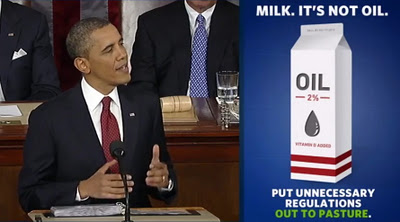
There’s no question that some regulations are outdated, unnecessary, or too costly. In fact, I’ve approved fewer regulations in the first three years of my presidency than my Republican predecessor did in his. (Applause.) I’ve ordered every federal agency to eliminate rules that don’t make sense. We’ve already announced over 500 reforms, and just a fraction of them will save business and citizens more than $10 billion over the next five years. We got rid of one rule from 40 years ago that could have forced some dairy farmers to spend $10,000 a year proving that they could contain a spill -- because milk was somehow classified as an oil. With a rule like that, I guess it was worth crying over spilled milk. (Laughter and applause.)
Now, I’m confident a farmer can contain a milk spill without a federal agency looking over his shoulder. (Applause.) Absolutely. But I will not back down from making sure an oil company can contain the kind of oil spill we saw in the Gulf two years ago. (Applause.) I will not back down from protecting our kids from mercury poisoning, or making sure that our food is safe and our water is clean. I will not go back to the days when health insurance companies had unchecked power to cancel your policy, deny your coverage, or charge women differently than men. (Applause.)
And I will not go back to the days when Wall Street was allowed to play by its own set of rules. The new rules we passed restore what should be any financial system’s core purpose: Getting funding to entrepreneurs with the best ideas, and getting loans to responsible families who want to buy a home, or start a business, or send their kids to college.
So if you are a big bank or financial institution, you’re no longer allowed to make risky bets with your customers’ deposits. You’re required to write out a “living will” that details exactly how you’ll pay the bills if you fail –- because the rest of us are not bailing you out ever again. (Applause.) And if you’re a mortgage lender or a payday lender or a credit card company, the days of signing people up for products they can’t afford with confusing forms and deceptive practices -- those days are over. Today, American consumers finally have a watchdog in Richard Cordray with one job: To look out for them. (Applause.)
We’ll also establish a Financial Crimes Unit of highly trained investigators to crack down on large-scale fraud and protect people’s investments. Some financial firms violate major anti-fraud laws because there’s no real penalty for being a repeat offender. That’s bad for consumers, and it’s bad for the vast majority of bankers and financial service professionals who do the right thing. So pass legislation that makes the penalties for fraud count.
And tonight, I’m asking my Attorney General to create a special unit of federal prosecutors and leading state attorney general to expand our investigations into the abusive lending and packaging of risky mortgages that led to the housing crisis. (Applause.) This new unit will hold accountable those who broke the law, speed assistance to homeowners, and help turn the page on an era of recklessness that hurt so many Americans.
Now, a return to the American values of fair play and shared responsibility will help protect our people and our economy. But it should also guide us as we look to pay down our debt and invest in our future.
Right now, our most immediate priority is stopping a tax hike on 160 million working Americans while the recovery is still fragile. (Applause.) People cannot afford losing $40 out of each paycheck this year. There are plenty of ways to get this done. So let’s agree right here, right now: No side issues. No drama. Pass the payroll tax cut without delay. Let’s get it done. (Applause.)
When it comes to the deficit, we’ve already agreed to more than $2 trillion in cuts and savings. But we need to do more, and that means making choices. Right now, we’re poised to spend nearly $1 trillion more on what was supposed to be a temporary tax break for the wealthiest 2 percent of Americans. Right now, because of loopholes and shelters in the tax code, a quarter of all millionaires pay lower tax rates than millions of middle-class households. Right now, Warren Buffett pays a lower tax rate than his secretary.
Do we want to keep these tax cuts for the wealthiest Americans? Or do we want to keep our investments in everything else –- like education and medical research; a strong military and care for our veterans? Because if we’re serious about paying down our debt, we can’t do both.
The American people know what the right choice is. So do I. As I told the Speaker this summer, I’m prepared to make more reforms that rein in the long-term costs of Medicare and Medicaid, and strengthen Social Security, so long as those programs remain a guarantee of security for seniors.
But in return, we need to change our tax code so that people like me, and an awful lot of members of Congress, pay our fair share of taxes. (Applause.)
Tax reform should follow the Buffett Rule. If you make more than $1 million a year, you should not pay less than 30 percent in taxes. And my Republican friend Tom Coburn is right: Washington should stop subsidizing millionaires. In fact, if you’re earning a million dollars a year, you shouldn’t get special tax subsidies or deductions. On the other hand, if you make under $250,000 a year, like 98 percent of American families, your taxes shouldn’t go up. (Applause.) You’re the ones struggling with rising costs and stagnant wages. You’re the ones who need relief.
Now, you can call this class warfare all you want. But asking a billionaire to pay at least as much as his secretary in taxes? Most Americans would call that common sense.
We don’t begrudge financial success in this country. We admire it. When Americans talk about folks like me paying my fair share of taxes, it’s not because they envy the rich. It’s because they understand that when I get a tax break I don’t need and the country can’t afford, it either adds to the deficit, or somebody else has to make up the difference -- like a senior on a fixed income, or a student trying to get through school, or a family trying to make ends meet. That’s not right. Americans know that’s not right. They know that this generation’s success is only possible because past generations felt a responsibility to each other, and to the future of their country, and they know our way of life will only endure if we feel that same sense of shared responsibility. That’s how we’ll reduce our deficit. That’s an America built to last. (Applause.)
Now, I recognize that people watching tonight have differing views about taxes and debt, energy and health care. But no matter what party they belong to, I bet most Americans are thinking the same thing right about now: Nothing will get done in Washington this year, or next year, or maybe even the year after that, because Washington is broken.
Can you blame them for feeling a little cynical?
The greatest blow to our confidence in our economy last year didn’t come from events beyond our control. It came from a debate in Washington over whether the United States would pay its bills or not. Who benefited from that fiasco?
I’ve talked tonight about the deficit of trust between Main Street and Wall Street. But the divide between this city and the rest of the country is at least as bad -- and it seems to get worse every year.
Some of this has to do with the corrosive influence of money in politics. So together, let’s take some steps to fix that. Send me a bill that bans insider trading by members of Congress; I will sign it tomorrow. (Applause.) Let’s limit any elected official from owning stocks in industries they impact. Let’s make sure people who bundle campaign contributions for Congress can’t lobby Congress, and vice versa -- an idea that has bipartisan support, at least outside of Washington.
Some of what’s broken has to do with the way Congress does its business these days. A simple majority is no longer enough to get anything -– even routine business –- passed through the Senate. (Applause.) Neither party has been blameless in these tactics. Now both parties should put an end to it. (Applause.) For starters, I ask the Senate to pass a simple rule that all judicial and public service nominations receive a simple up or down vote within 90 days. (Applause.)
The executive branch also needs to change. Too often, it’s inefficient, outdated and remote. (Applause.) That’s why I’ve asked this Congress to grant me the authority to consolidate the federal bureaucracy, so that our government is leaner, quicker, and more responsive to the needs of the American people. (Applause.)
Finally, none of this can happen unless we also lower the temperature in this town. We need to end the notion that the two parties must be locked in a perpetual campaign of mutual destruction; that politics is about clinging to rigid ideologies instead of building consensus around common-sense ideas.
I’m a Democrat. But I believe what Republican Abraham Lincoln believed: That government should do for people only what they cannot do better by themselves, and no more. (Applause.) That’s why my education reform offers more competition, and more control for schools and states. That’s why we’re getting rid of regulations that don’t work. That’s why our health care law relies on a reformed private market, not a government program.
On the other hand, even my Republican friends who complain the most about government spending have supported federally financed roads, and clean energy projects, and federal offices for the folks back home.
The point is, we should all want a smarter, more effective government. And while we may not be able to bridge our biggest philosophical differences this year, we can make real progress. With or without this Congress, I will keep taking actions that help the economy grow. But I can do a whole lot more with your help. Because when we act together, there’s nothing the United States of America can’t achieve. (Applause.) That’s the lesson we’ve learned from our actions abroad over the last few years.
Ending the Iraq war has allowed us to strike decisive blows against our enemies. From Pakistan to Yemen, the al Qaeda operatives who remain are scrambling, knowing that they can’t escape the reach of the United States of America. (Applause.)
From this position of strength, we’ve begun to wind down the war in Afghanistan. Ten thousand of our troops have come home. Twenty-three thousand more will leave by the end of this summer. This transition to Afghan lead will continue, and we will build an enduring partnership with Afghanistan, so that it is never again a source of attacks against America. (Applause.)
As the tide of war recedes, a wave of change has washed across the Middle East and North Africa, from Tunis to Cairo; from Sana’a to Tripoli. A year ago, Qaddafi was one of the world’s longest-serving dictators -– a murderer with American blood on his hands. Today, he is gone. And in Syria, I have no doubt that the Assad regime will soon discover that the forces of change cannot be reversed, and that human dignity cannot be denied. (Applause.)
How this incredible transformation will end remains uncertain. But we have a huge stake in the outcome. And while it’s ultimately up to the people of the region to decide their fate, we will advocate for those values that have served our own country so well. We will stand against violence and intimidation. We will stand for the rights and dignity of all human beings –- men and women; Christians, Muslims and Jews. We will support policies that lead to strong and stable democracies and open markets, because tyranny is no match for liberty.
And we will safeguard America’s own security against those who threaten our citizens, our friends, and our interests. Look at Iran. Through the power of our diplomacy, a world that was once divided about how to deal with Iran’s nuclear program now stands as one. The regime is more isolated than ever before; its leaders are faced with crippling sanctions, and as long as they shirk their responsibilities, this pressure will not relent.
Let there be no doubt: America is determined to prevent Iran from getting a nuclear weapon, and I will take no options off the table to achieve that goal. (Applause.)
But a peaceful resolution of this issue is still possible, and far better, and if Iran changes course and meets its obligations, it can rejoin the community of nations.
The renewal of American leadership can be felt across the globe. Our oldest alliances in Europe and Asia are stronger than ever. Our ties to the Americas are deeper. Our ironclad commitment -- and I mean ironclad -- to Israel’s security has meant the closest military cooperation between our two countries in history. (Applause.)
We’ve made it clear that America is a Pacific power, and a new beginning in Burma has lit a new hope. From the coalitions we’ve built to secure nuclear materials, to the missions we’ve led against hunger and disease; from the blows we’ve dealt to our enemies, to the enduring power of our moral example, America is back.
Anyone who tells you otherwise, anyone who tells you that America is in decline or that our influence has waned, doesn’t know what they’re talking about. (Applause.)
That’s not the message we get from leaders around the world who are eager to work with us. That’s not how people feel from Tokyo to Berlin, from Cape Town to Rio, where opinions of America are higher than they’ve been in years. Yes, the world is changing. No, we can’t control every event. But America remains the one indispensable nation in world affairs –- and as long as I’m President, I intend to keep it that way. (Applause.)
That’s why, working with our military leaders, I’ve proposed a new defense strategy that ensures we maintain the finest military in the world, while saving nearly half a trillion dollars in our budget. To stay one step ahead of our adversaries, I’ve already sent this Congress legislation that will secure our country from the growing dangers of cyber-threats. (Applause.)
Above all, our freedom endures because of the men and women in uniform who defend it. (Applause.) As they come home, we must serve them as well as they’ve served us. That includes giving them the care and the benefits they have earned –- which is why we’ve increased annual VA spending every year I’ve been President. (Applause.) And it means enlisting our veterans in the work of rebuilding our nation.
With the bipartisan support of this Congress, we’re providing new tax credits to companies that hire vets. Michelle and Jill Biden have worked with American businesses to secure a pledge of 135,000 jobs for veterans and their families. And tonight, I’m proposing a Veterans Jobs Corps that will help our communities hire veterans as cops and firefighters, so that America is as strong as those who defend her. (Applause.)
Which brings me back to where I began. Those of us who’ve been sent here to serve can learn a thing or two from the service of our troops. When you put on that uniform, it doesn’t matter if you’re black or white; Asian, Latino, Native American; conservative, liberal; rich, poor; gay, straight. When you’re marching into battle, you look out for the person next to you, or the mission fails. When you’re in the thick of the fight, you rise or fall as one unit, serving one nation, leaving no one behind.
One of my proudest possessions is the flag that the SEAL Team took with them on the mission to get bin Laden. On it are each of their names. Some may be Democrats. Some may be Republicans. But that doesn’t matter. Just like it didn’t matter that day in the Situation Room, when I sat next to Bob Gates -- a man who was George Bush’s defense secretary -- and Hillary Clinton -- a woman who ran against me for president.
All that mattered that day was the mission. No one thought about politics. No one thought about themselves. One of the young men involved in the raid later told me that he didn’t deserve credit for the mission. It only succeeded, he said, because every single member of that unit did their job -- the pilot who landed the helicopter that spun out of control; the translator who kept others from entering the compound; the troops who separated the women and children from the fight; the SEALs who charged up the stairs. More than that, the mission only succeeded because every member of that unit trusted each other -- because you can’t charge up those stairs, into darkness and danger, unless you know that there’s somebody behind you, watching your back.
So it is with America. Each time I look at that flag, I’m reminded that our destiny is stitched together like those 50 stars and those 13 stripes. No one built this country on their own. This nation is great because we built it together. This nation is great because we worked as a team. This nation is great because we get each other’s backs. And if we hold fast to that truth, in this moment of trial, there is no challenge too great; no mission too hard. As long as we are joined in common purpose, as long as we maintain our common resolve, our journey moves forward, and our future is hopeful, and the state of our Union will always be strong.
Thank you, God bless you, and God bless the United States of America. (Applause.)
END 10:16 P.M. EST
##
 President Obama on Monday held his first-ever virtual interview during a "hangout" on Google +. A follow up to last week's State of the Union Address, the President answered questions ranging from why he's sending money to Afghanistan to plans for his upcoming twentieth wedding anniversary.